Notes
- Problem statement: To land on Mars you need a high ballistic coefficient
- How to land on Mars: Explain the phases of flight (illustrations and charts, explain the charts)
- Model summary (link other blog post)
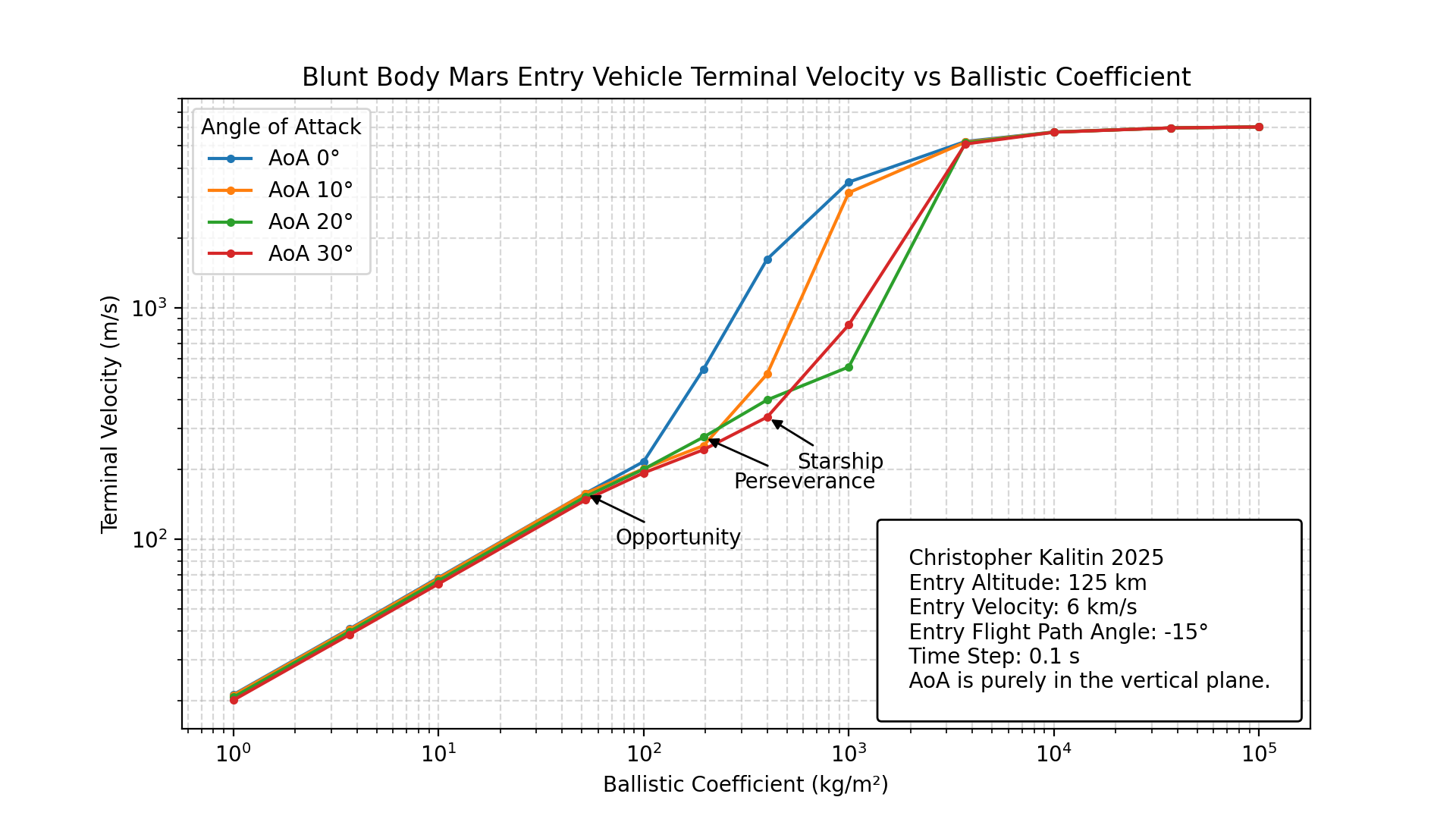
- Chart summary (general trend and edge cases)
Ballistic Coefficient Points of Interest:
- The first divergence at BC=100 occurs because AoA=0 no longer reaches terminal velocity. (it’s not falling straight down).
- At BC=196 (Perseverance) AoA=20 is above AoA=10 because it’s falling straight down after a skip.
- At BC=1000, The great divergence occurs because at AoA=10 you get a collision and no skip. No skip!
- At BC=1000, AoA=30 is above AoA=20 because it again is falling straight down after a skip.
Structure:
- Introduction
- Companion Post
- Overview of Mars landing
- Max atmospheric decelleration
- Hence, min ballistic coefficient
- Casey Handmer / Starship / Blunt Body examples
- Model:
- First result (in the limit to zero, 0 vel - limit to inf, entry velocity)
- Then, Perseverance test and I realize AoA is extremely important
- AoA Chart with divergence at ~1000 BC
- First divergence at BC=100 because no terminal velocity, and higher AoA reaches v_t faster
- Then, Perseverance at BC=196 bc too high skip and BC=1000 AoA=30 > AoA=20