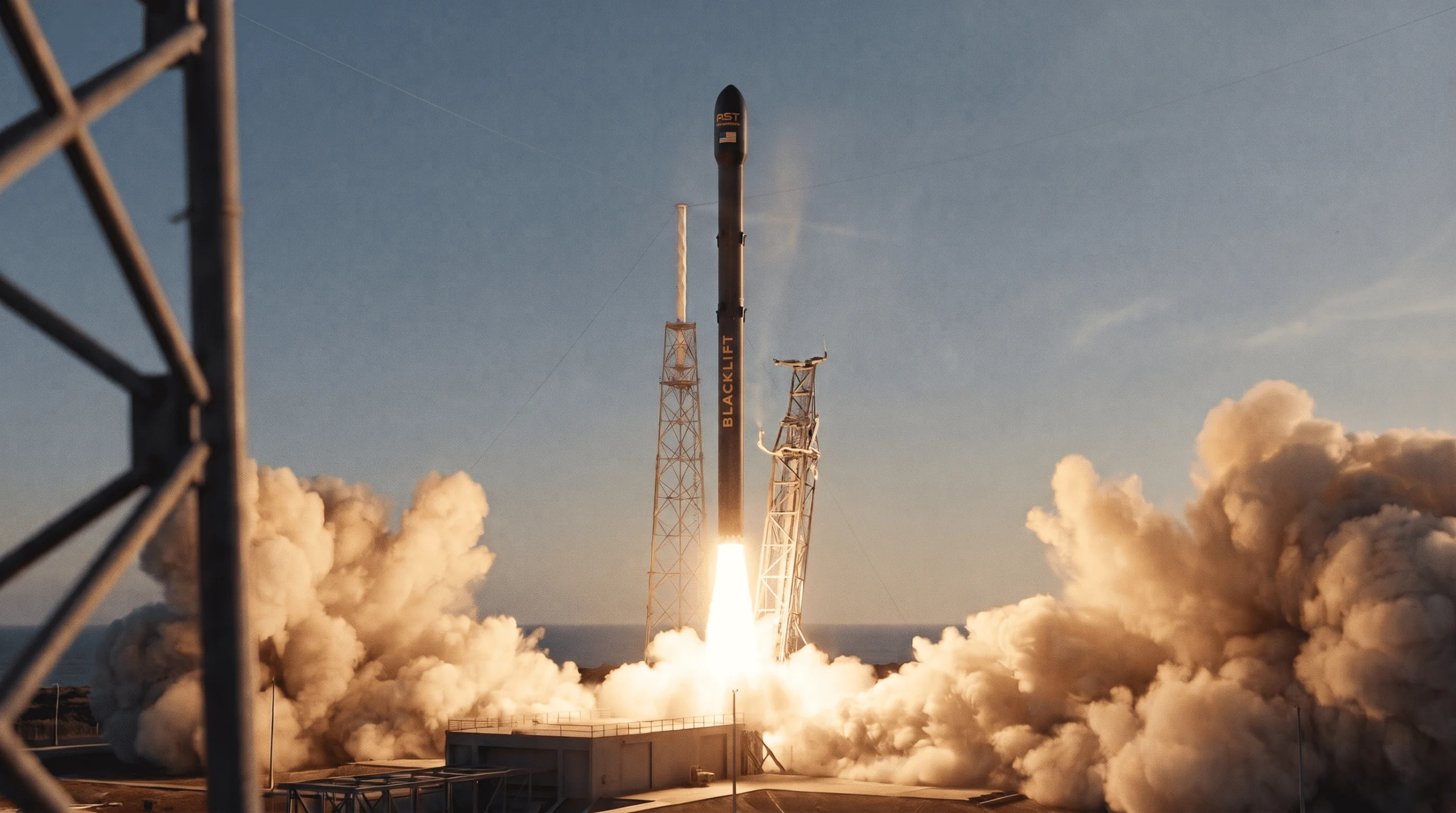
AST SpaceMobile recently announced their Blacklift launch vehicle to the great satisfaction of those of us that love debating the launch market on X.
Blacklift is a partially reusable launch vehicle with a 20 ton payload capacity to LEO. This makes it functionally very similar to SpaceX’s Falcon 9 and nearly every other partially reusable launch vehicle currently under development or launching in the US and China.
AST SpaceMobile provides cellular data from a constellation of LEO satellites, and like every other launch customer they have been feeling the shortage of launch availability. In the Blacklift unveiling event they state that launch supply is their bottleneck, at the rate of other launch companies they’d need to wait 10 years to launch their full constellation, that building their own launch vehicle will get them 75% cheaper costs, and that every week of delayed launch costs ~$20M.
In this blog post I will describe why it is rational for every major launch consumer to develop an internal launch vehicle, my predictions for the launch market over the next decade, and if AST will be able to succeed - especially against Starlink.
Internalize Risk To Unlock Markets - Why Satellite and Launch Companies Converge
“I’ve said for 10+ years: at scale, every launch company becomes a satellite company, and every satellite company becomes a launch company.”
Rahul Goel is building NordSpace, a full-stack satellite and launch company in Canada. I’ve previously written about NordSpace. He fundamentally understands that the path to unlocking the most value in the space industry is internalizing all the major risks and building businesses around every one of them.
This parallels Rocket Lab’s strategy. They carved out a niche with the Electron rocket, then began building in-house satellite systems with Photons, then acquiring every major supplier that could be integrated into their existing businesses well, and finally being a prime contractor on numerous missions like the NASA Escapade Mars probes and acquiring Iridium to own the full stack of space value creation end-to-end. A truly amazing success story.
Internalizing major risks reduces probability of delay and excessive costs (assuming a competent team can be assembled) while unlocking new markets.
For example, I recently wrote a blog post about How Starlink Will Conquer The Earth’s Telecommunications Layer. Starlink isn’t just satellite internet that serves rural customers that don’t have terrestrial broadband. Because SpaceX built the cheapest launch vehicle in history, manufactures thousands of satellites, and owns the full stack allowing them to iterate quickly, they have been able to prove out Starlink V3 which will enable them to be price competitive with terrestrial broadband even in major urban centers.
I worked with Casey Handmer at Terraform Industries over the summer, and his strategy is centered around internalizing risk. Terraform internalizes all major technical risks and does not settle for any solution that isn’t price competitive enough To Conquer The Primary Energy Layer Of Civilization. This will allow us to make all the hydrocarbons the world consumes, and is in contrast to competitors which weren’t able to solve core technical problems like direct air capture of CO2 and decide to outsource it.
The path to capturing the most value in a given market is by owning the entire stack. SpaceX achieved this with Starlink, Falcon 9, and Starship; Rocket Lab will achieve this with Neutron, in-house full-stack satellite manufacturing, and Iridium; Terraform will achieve this through vertical integration of Electrolysis, DAC, and chemical reactors.
John D. Rockefeller did the majority of this process with Standard Oil. He acquired and built 90% of oil refining capacity in America and in-sourced the process of building the biggest oil refineries in the world. This story provides an illustrative example because part of his undoing was due to collusion with railroads for cheaper transportation of his products, which led to poor public relations - ie. working with an external supplier on a critical part of the business. Austin Vernon’s writeup of this story is a great read.
The Upcoming Decades Of Launch Availability
The reason AST got into this mess is that they haven’t been able to secure enough launch to build out their constellation. The critical assumption behind their intention to build a launch vehicle is low availability of launch supply, so this must be examined. Eric Berger previously wrote an article on all of the players in this space, which is a good primer.
SpaceX
“There are zero vendors. So you know to call it a market is actually a misnomer. Right now if you try to buy launch from SpaceX, they won’t sell it to you basically under any circumstances. They will not sell you traditional launch services that are useful for either of these two applications [Telecom or compute].”
From the beginning, SpaceX has been building Starship to satisfy their own launch demand - whether this is a Mars program or Starlink. Because SpaceX can make so much more from their own payloads (Starlink and Starmind AI compute satellites), they are incentivized away from launching payload for external customers, including NASA(!).
In my Starlink blog post, I laid out the path to SpaceX launching 100,000 Starlink V3 satellites which is sufficient demand for ~2000 Starship launches. Furthermore, SpaceX’s Starmind satellites appear like they will saturate all Starship launch capacity long into the future. Each Starmind launch on Starship will put ~10 MW of AI compute in orbit. SpaceX plans to scale to >100 GWs of AI compute in the next few years which is enough demand for tens of thousands of Starship launches.
Relativity
One alternative to SpaceX is Relativity Space which Eric Schmidt (former Google CEO) recently acquired a majority stake in and made himself CEO. Eric Schmidt did this because he saw the potential of AI data centers in orbit. So, Relativity is likely to saturate their own launch supply as well.
Blue Origin
Blue Origin is making great progress with the New Glenn rocket. However, they have significant launch contracts with Amazon Leo, NASA’s Artemis program, and their own internal TeraWave satellite constellation. AST has previously launched their satellites with Blue Origin, but due to massive internal and external demand for New Glenn launches from higher priority customers (like NASA’s Artemis program), Blue Origin is not incentivized to give AST a great number of launches.
Rocket Lab and Stoke Space
Rocket Lab and Stoke Space are the biggest players left. They both don’t have programs to fully saturate their launch supply and are signing contracts with many external customers. This provides a path to securing launch demand, but AST requires potentially hundreds of launches and has to compete with every other company demanding launch from Rocket Lab and Stoke. To put the cherry on top, they both recently signed a launch deal with Starcloud, which makes AI compute satellites.
Maybe they will be nice like Jensen was, and distribute their supply among many customers. However, this is not a guaranteed path for AST to secure the number of launches they require.
Firefly Aerospace
There is one player I haven’t mentioned yet, Firefly Aerospace. They have the latest launch date of any of the companies mentioned above, with their Eclipse vehicle not launching before 2029.
Firefly appears to be the least focused of all the launch companies pursuing partial reusability. They have their own vehicle Eclipse, and is also collaborating with Northrop to make the Antares 330 vehicle that has similar engines but replaces the second stage with a solid rocket motor. As I’ve previously written, Antares has been a poor example of attempting to compete with SpaceX.
Firefly is attempting to derisk their launch program by collaborating with as many other companies as possible. This leads to externalizing risk and responsibility, which as we saw in the previous section, is not the best strategy to outsized gains in the launch market.
It’s really quite silly to have three launch vehicles with the same engines and very similar carbon composite first stages all launching from the same site (Wallops Island). What would be if Tom Markusic (Firefly founder) was still around?
Additional Insights On The Launch Market
The Case For SpaceX Selling To External Customers
Brian Timar replied to me with the interesting case of SpaceX’s scale getting so big that launching all external payloads is a minority of their total launches and that this could be a strategy to “defuse cries of “monopoly!""
The rough numbers behind this case are that AST, Amazon Leo, etc. give demand for ~5 kilotonnes of satellites to LEO per year. That’s about 50 Starships worth. Layering on demand from the other AI compute and telecommunications constellations brings this to 100s of launches per year.
SpaceX’s strategy in this respect appears to be willingness to launch customer payloads that adhere to their pez dispenser satellite form factor, and being less willing to launch arbitrarily sized payloads on Starship. This is the lowest cost path to SpaceX launching external customer payloads.
When Starship Flight 14 carried 26 Starlink V3 satellites to orbit I used my Starlink Model to determine how much revenue those satellites would generate over their lifetime and came to 3.9B in revenue. This may be lower than the real value due to not all of the frequency spectrum being used, but it illustrates why SpaceX vastly prefers their own in-house payloads to eg. a $200M launch for an external customer. This is a 10x increase in revenue for an internal payload vs external customer!
Aside on China’s Launch Market
China’s launch market has far more launch companies without internal demand than the American market. LandSpace, Space Pioneer, i-Space, Deep Blue Aerospace, etc. all have launched or are developing partially reusable launch vehicles.
This paints a picture of China’s launch companies lacking internal demand, leading to a more competitive environment for external launch customers.
Because China’s satellite internet constellations Qianfan and Guowang are state-backed and the launch vehicles are owned by private companies, we may not see the same convergence of satellite and launch companies as is shown in the American market. China’s launch market may be competitive enough that it isn’t a required step for satellite constellations to in-source launch to remain price competitive.
The Reasoning Behind Internalizing Launch
“We have a date in the back of our heads where if the launch market doesn’t fix itself we are going to go build a launch company and the reason that we have to do it is because we want our customers to be successful.”
The CEO of Starpath went on Ti Morse’s excellent podcast Relentless recently and spelled out the logic behind why so many satellite companies are looking toward in-sourcing launch. This podcast formed the basis for the insights in this blog post.
The fundamental trade-off that occurs at every western launch company is between launch prices and launch costs. SpaceX achieved ~70M. That difference in cost is what every launch company is aiming for, and if achieved it gives them a big cost advantage for internal space applications like satellite internet or AI compute satellites.
The extremely high launch gross margins lead to a world in which every launch company is incentivized to become a satellite constellation company and not launch external customer payloads. Notice the contrast between this market and how I described China’s launch market in the previous section.
Cowboy Space came to the same conclusion and decided to build AI data center satellites and a custom launch vehicle for them in-house.
Can AST Build Their Own Launch Vehicle?
“Terrible idea. Genuinely a really bad idea. Don’t even have time to list all the reasons. But also, there’s not really an alternative here. Like I said, living on borrowed time.”
“I’m all for the wisdom of building your own if you have sufficient payload you want to launch (which should be measured in kilotons at a minimum) and think you can beat future market pricing. But you need realistic timelines.”
SpaceX is the most successful launch company in the world because Elon Musk is the best in the world at talent development. He has built organizations of hundreds of thousands of people where the most capable engineers get tested to the limits of their ability, and every time a test is passed they bubble up to the top of the organization. Great people are fundamentally the limiting factor behind progress on the hardest problems humanity faces.
In contrast, AST has shown the ability to manufacture dozens of cellular broadband satellites, contract relationships with Mobile Network Operators, contract launch for a few of their satellites, raise billions, and not much more. This is far more than Cowboy Space, but given the graveyard of failed launch companies it does not guarantee success. Furthermore, in their Blacklift unveiling presentation they claim launch isn’t a hard problem! (Though I see the idea behind this sentiment)
Blacklift uses carbon composite tanks, which AST uses on their satellites. Large scale cryogenic rated carbon composite tanks are a very hard problem. SpaceX pivoted away from using them in the early days of Starship and they’ve recently been the cause of delays to the first launch of Rocket Lab’s Neutron rocket.
To reduce risk and shorten timelines they’ve licensed Firefly’s Miranda and Vira engines and plan to launch from Wallops Island, the same site as Firefly’s Eclipse vehicle and Northrop’s Antares 330 which also uses the Miranda engine. However, they haven’t properly received approval to use that launch site and their partners don’t appear to be on the same page.
The reason AST thinks building a launch vehicle is an easy problem is because all the technical problems have been solved in the past (and they’ve acquired an engine). However, a tremendous amount of execution lies ahead and they have not demonstrated the ability to execute on extremely difficult technical projects. In the age of super intelligence, execution is the moat.
AST SpaceMobile Doesn’t Have To Compete With Starlink
Seeing as we’ve gotten this far into analysis of AST SpaceMobile, we might as well do an analysis of their competitive position in the cellular data market and competition with Starlink as well.
AST’s go to market strategy and the portion of the cellular data market they’re capturing allow them to never be in direct competition with Starlink. The strategy of going after a niche that SpaceX isn’t interested in pursuing or structurally cannot has been a successful strategy when in the same market as SpaceX, as illustrated by Rocket Lab’s success with the Electron rocket.
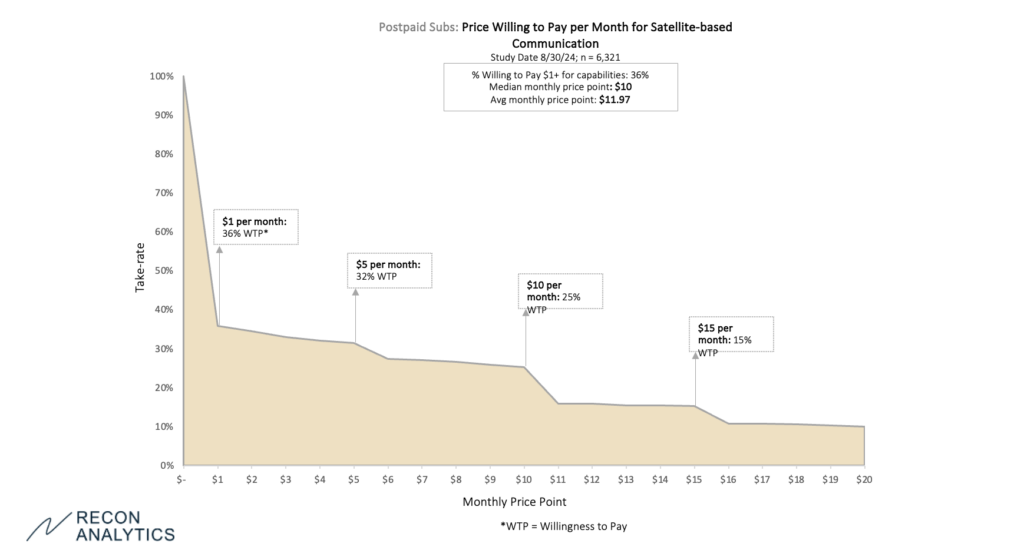
AST’s primary product is an add-on to existing cellular data plans that gives customers the ability to access satellite cellular data whenever they are not in range of a cell tower. Above you can see a model of how many customers would be willing to pay for this service at a range of price points. ASTS projects ~$2/month/user in their 2020 SPAC filing ARPU model (page 138).
AST’s strategy is to sell to Mobile Network Operators (MNOs), that then sell add-ons to customers. Thus far, they have $1.2B in contracted revenue commitments with ~60 MNOs that service ~3 billion subscribers. This goes to show how their MNO partnership strategy gives them access to a huge number of customers for relatively little upfront investment.
The MNOs also give AST access to a substantial amount of RF spectrum, which is famously very expensive and difficult to obtain (See the end of Chapter 5 of Eccentric Orbits). For reference, SpaceX has spent ~$30B on cellular spectrum between the EchoStar and Grain Management deals.
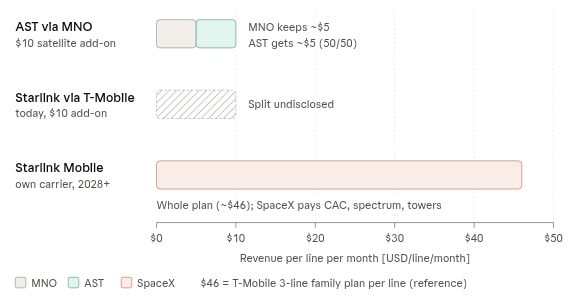
However, this MNO partnership strategy does not come for free. AST’s deal with the MNO Vodafone has a 50/50 revenue split and AST has stated that they expect similar deals in the future. This means that of the ~$2-10 that MNOs could charge customers, AST will see ~50% of it and the MNO nets the rest as the fee for having built a user base for AST to offer services to.
AST has managed to position themselves in contrast to Starlink, which is aiming to be a network operator themselves. The market price for cellular data will be obeyed for both, so there’ll be no race to the bottom on costs. ASTS will capture ~5-10% of the price of a cellular subscription while SpaceX will take 100% of the customers they can win. The strategy of going straight to being a mobile network operator is only something SpaceX could do with its extreme scale, as I outline in my Starlink blog post.
For AST to be successful they have to capture a critical number of customers at a suitable gross profit margin. Partnering with MNO agreements guarantees distribution to some extent. It also externalizes risk (the opposite of SpaceX’s strategy), which means they will be able to capture less of the value long-term. I am confident in their ability to build satellites cheap enough to get a positive gross profit margin given that in my Starlink blog post I found that even V1.0 Starlink satellites are cheap enough to service the majority of the world’s broadband usage. They won’t have to compete with Starlink on cost, so there is little risk of a race to the bottom on costs. Overall, this isn’t a difficult business case to make - provided abundant and relatively cheap launch is available.
Conclusion
The defining characteristic of the American launch market is that gross profit margins are extremely high and launch demand is far greater than supply. This leads to a large incentive for vertical integration of launch vehicles and satellites, which has played out with SpaceX; Rocket Lab and NordSpace are in the process of implementing; and Cowboy Space, Starpath, and AST have noticed.
This makes AST’s decision to internalize launch capability entirely logical. However, it does not guarantee success in building a successful launch vehicle on time or budget, which has time and again proven to be something the majority of organizations fail at.