V2 Rocket Combat Effectiveness - Reading Walter Dornberger's Account
“Ever since the huge bomber losses during the attack on England in 1940, my colleagues and I had been firmly convinced that defeat in the air on the western front could be prevented, if at all, only by the employment of guided missiles of very great range and effect. In the long run the Luftwaffe would not be able to afford the continued loss of valuable flying crews.”
- Walter Dornberger, V2, page 71
I have slowly been reading V2 by Walter Dornberger over the last few months. Dornberger was the major general that led the development of the V2 rocket in Nazi Germany. As Groves was to Oppenheimer, Dornberger was the military general coordinating the V2 program while von Braun was technical director.
The book is very much a first person perspective on German rocket development starting around 1930. It is sometimes too first person, as one of the chapters is Dornberger running around Peenemunde (The V2 developmental launch and production site) putting out fires during Allied bombing. Interspersed through first person accounts of Hitler viewing a rocket firing and accounts of test launches are great insights into German R&D and mismanagement of technical resources. I certainly have a blog post in me about how impossible it would have been for Germany to produce a Nuclear Weapon, but this will wait until I’ve read Speer’s memoirs.
Concurrently, I’ve watched several videos by WWII US Bombers. This channel is clearly run by a neurodivergent manic autist (literally me!) and produces extremely good videos on extremely niche WW2 topics. Some highlights are the recent series on V2 combat effectiveness as compared to the B-24 and German synthetic fuel production. These videos mainly source quantitative information from the United States Strategic Bombing Survey to illustrate points, an excellent strategy drawing on the great intellectual output of our forefathers.
Between the book and these videos, I have some commentary on the combat effectiveness of the V2 and German armaments production.
My (far too thorough) notes on the book are available here.
For feedback / criticism, please reply here.
Fun Stories From The Early History of German Rocketry
Rocket development in pre-war Germany began due to the Treaty of Versailles restricting conventional military development. The German Army Weapons Department looked to experimental technology for potential R&D paths, while they were limited by Versailles.
In 1929, General / Professor Becker ran the Army Weapons Department and suggested undertaking rocket propulsion research for military purposes. At the time, no serious industry nor technical colleges were interested in high powered rocket propulsion, so the Army Weapons Department financed individual inventors and awaited their results.
To put this into proper perspective, the V2 was the rocket that spawned the Soviet and American rocket programs after the war and has direct lineage to the N1 and Saturn 5. It was the most advanced rocket, and maybe the most advanced aerospace vehicle, in the world during the Second World War. And all of this work began through a bet on eccentric rural inventors in Germany.
The Army Weapons Department began its own development program, as the individual inventors didn’t seem to produce anything of note. This work took place at the Kummersdorf proving ground near Berlin, and in 1932, then 19-year-old Werner von Braun joined the team.
Periodically, the individual inventors came into the department with their design ideas, and some of these men were recruited into the program. These include Arthur Rudolph, who invented a 650 lbf 60 second liquid motor, Albert Pullenberg, and others.
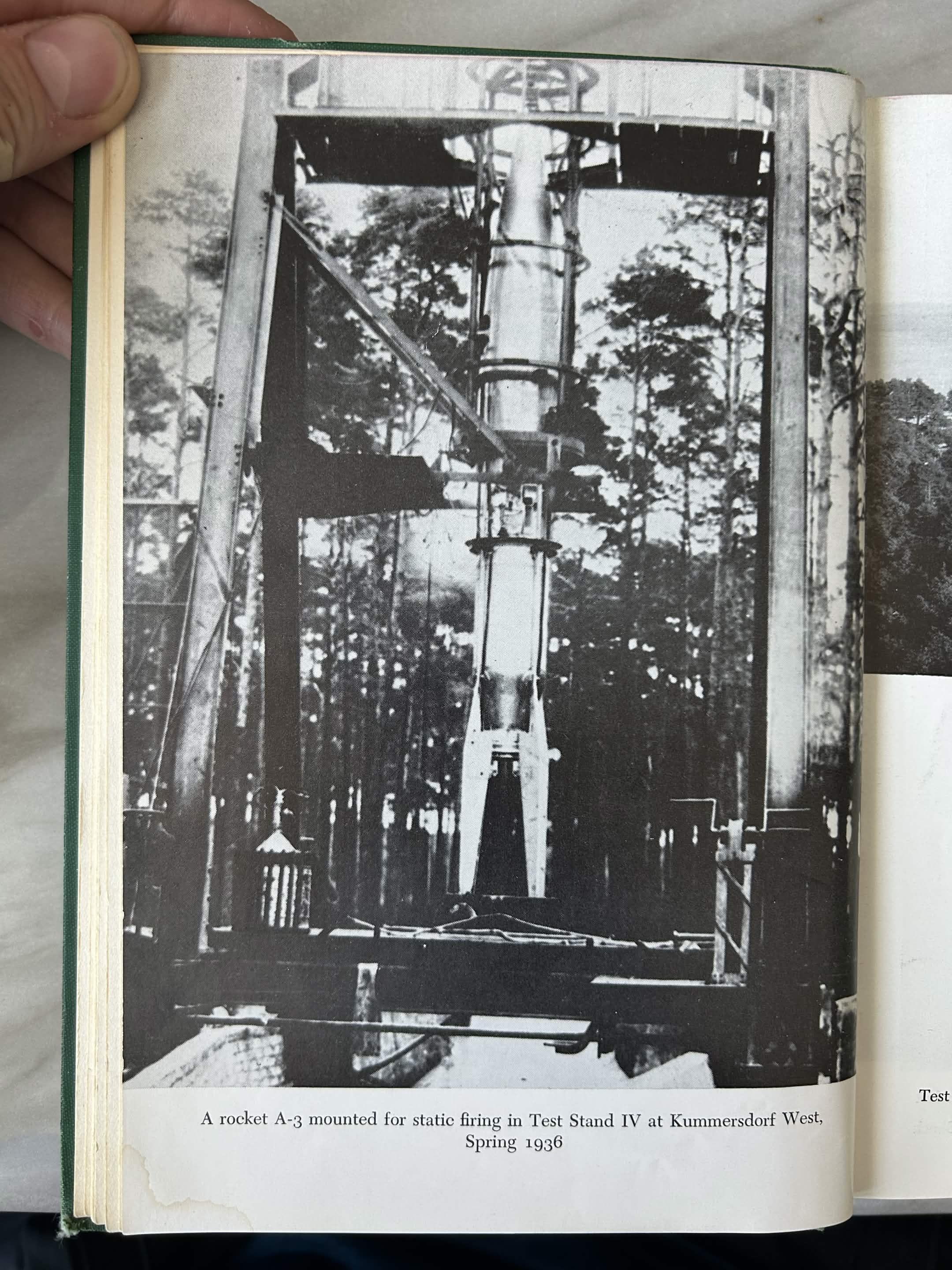
Their work led into the A-1 rocket. It stood 1.5 meters tall, massed 330 lb and had a 85 lb spinning mass on its nose to maintain attitude, in the same style as Explorer I.
The book contains very many fun anecdotes and stories from this early development, paralleling Ignition by John D. Clark. I’ll get into the actual insights I want to describe instead of recounting the book now. My notes briefly go over some of the stories if you’re interested.
The V2 Was Meant To Replace Aerial Bombers
“Ever since artillery existed military strategists have dreamed of an ideal projectile with a greater range than the shell. Even while the airplane was entering on its triumphant career, the strategists began to want some carrier of explosive that would be still cheaper to manufacture and simpler to service than, say, a bomber. The V-2 met this requirement.”
- Walter Dornberger, V2, page 19
The military appeal of the V2 as a weapon was as a substitute for long-range artillery and aerial bombers.
It had an explosive payload of ~1.5 tonnes, which constituted the majority of it’s energy released on impact.
We can contrast this to the Ju-88 medium bomber which was used during the battle of Britain and had a payload of ~2 tonnes.
If the V2 could be produced for cheaper than the cost of Ju-88 divided by the number of flights it would get during it’s lifetime, it could be an economically competitive weapon.
The V2 was often benchmarked in the book against artillery. They targeted a 0.2-0.3% accuracy (page 48), this is expressed as the 50th percentile impact position distance from the target multiplied by range. Eg. if a 100 km artillery gun had an accuracy of 1%, it’s 50th percentile dispersion would be 1 km from the target. In the end, they seemed to achieve <1% accuracy.
V2 sizing was benchmarked off the Paris Gun, which was capable of firing a 210 mm shell with 23 lb of high explosive 80 miles. Greater range and payload necessitated a rocket, and this drove their preliminary design goal of a 160 miles range with a 1 ton payload.
The wind tunnel at Peenemunde - the site at which V2 development took place - even did work on testing arrow-like artillery projectiles and they succeeded in extending the range of a 280 mm artillery shell from 37-57 miles to 85-93 miles.
The V2 Was An Unsuccessful Trade Between Bomber Amortization And V2 Unit Cost
“The threadbare argument that our A-4 was too costly in comparison with the heavy bomber became more and more difficult to uphold in the light of experience over England. If, as accurate statistics showed, a bomber was shot down after an average of five or six flights over England, if it could carry only a total of six to eight tons of bombs during its active existence, and if the total loss of a bomber, including the cost of training the crew, were estimated at about thirty times the price of an A-4 (38,000 marks), then it was obvious that the A-4 came off best.”
- Walter Dornberger, V2, page 71
Walter Dornberger lays out the math for V2 combat economics above, and he bases his arithmetic on the attrition rate of German bombers during the Battle of Britain.
As WWII US Bombers did, we can examine some historic papers from the time to see if Dornberger’s conclusion is a reasonable one. WWII US Bombers already did a great review of these papers, hopefully I can add some useful insights by contrasting to Dornberger’s writing.
Directly applicable primary sources are difficult to find in the vast trove of information on the second world war, so some sources are secondary and come from individual that have clearly spent a non-trivial portion of their lives obsessing about the Second World War.
Christos T. (“A simple economist with an unhealthy interest in military and intelligence history.”) gives us these numbers on German bomber attrition rates in the Eastern and Western fronts:
- 0.00703 losses per sortie in the Eastern Front (142 sorties expected life)
- 0.0537 losses per sortie in the Western Front (19 sorties expected life)
Already, in the second worst period for German bombers in World War Two (the Western front after the Battle of Britain), we are at an expected lifetime of 19 sorties for a bomber. This is vastly greater than Dornberger’s assumption of 5-6, invalidating a fundamental assumption.
Next, we can get onto cost.
The National Air and Space Museum lists V2 unit cost (without warhead and guidance systems) at 100,000 Reichmarks, later getting down to 75,000 RM. Wikipedia claims 50,000 RM from a book that isn’t easily available on the internet.
Even the most optimistic figure above is greater than Dornberger’s 38,000 Reichmarks goal.
Next we can compare the cost of manufacturing a V2 to a Ju-88, which had ~15k total units built and was one of the primary bombers used during the battle of Britain. Page 39 of this Yale report gives us ~350,000 Reichmarks per Ju-88, with cost slightly decreasing with time.
Unrelated, but on page 40 that report also states that Junkers had a ~10% operating profit through the war, decreasing by a couple percent through time.
The 350k RM figure above doesn’t include the cost of training crew - and the cost of killing pilots - but above we already showed that sorties per plane (and hence crew) were far higher than Dornberger’s estimates.
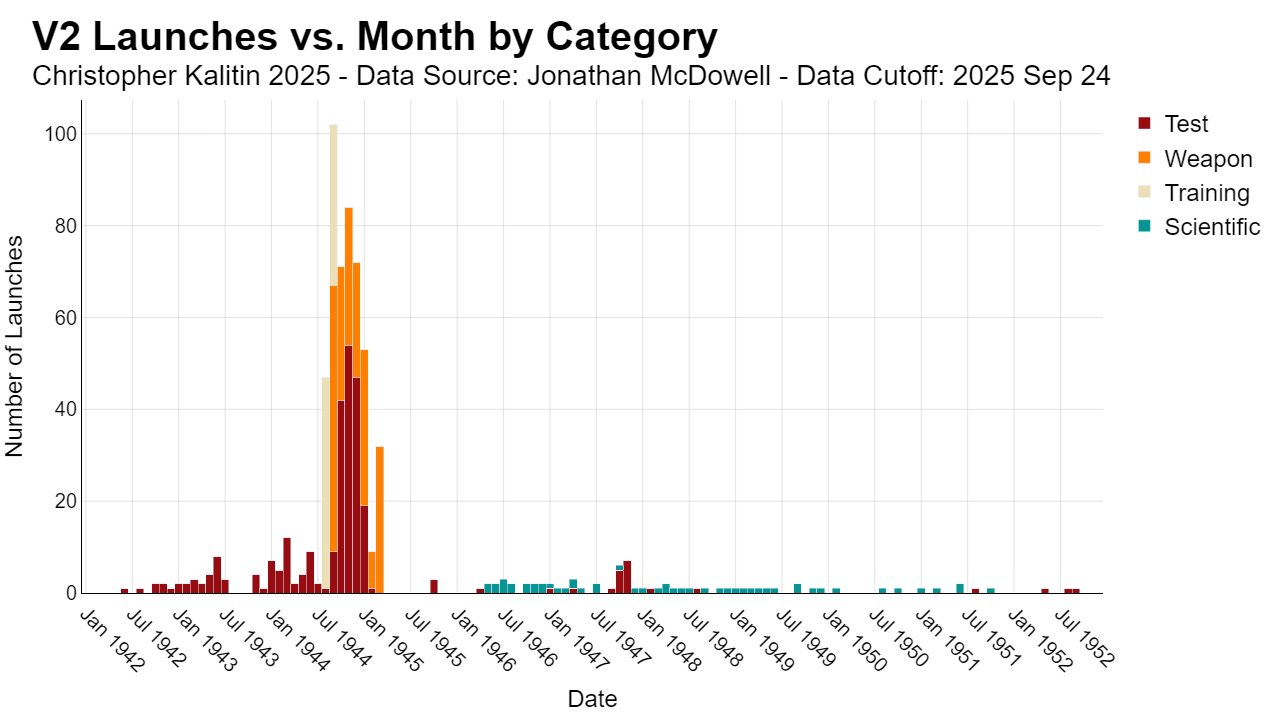
In the end the V2 cost 500,000 Reichmarks per launch, including amortization of R&D costs, so not exactly unit costs. These costs were amortized over a few thousand V2’s launched during the war - compared to ~200 launches per year of orbital rockets today, a great technological feat.
The conclusion here is that Walter Dornberger based his core assumptions around V2 combat effectiveness around the most pessimistic bomber lifetime numbers available and optimistic cost targets. Additionally, the V2 would never become accurate enough to strike specific facilities, even ones as big as the Leuna Synthetic Fuel Works.
Hence, the V2 was a great program to further humanity’s technological ability in aerospace, but was a very ineffective weapon.
A-9, -10, -11, -12 Orbital Rockets
Before I close out this blog post, I’d like to show the concepts from the A-9,-10,-11, and -12 rockets which had Germany not lost the war, could have been part of the family of the first orbital rockets. This shows an interesting exercise in designing an orbital-class launch vehicle with very limited technology.
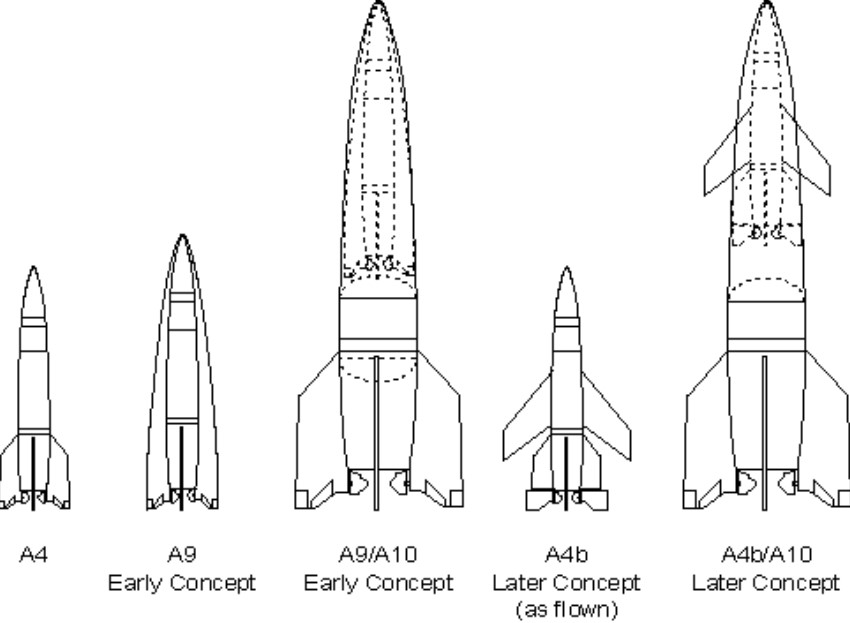
First, the A-9 / A-10 were meant to be a two-stage rocket capable of impacting the United States. The A-9 had far greater surface area fins than the A-4 and it would have spent the majority of it’s time over the Atlantic gliding in the upper atmosphere. The A-10 would have used a cluster of 6 A-4 combustion chambers feeding into a single expansion nozzle, according to the Encyclopedia Astronautica.
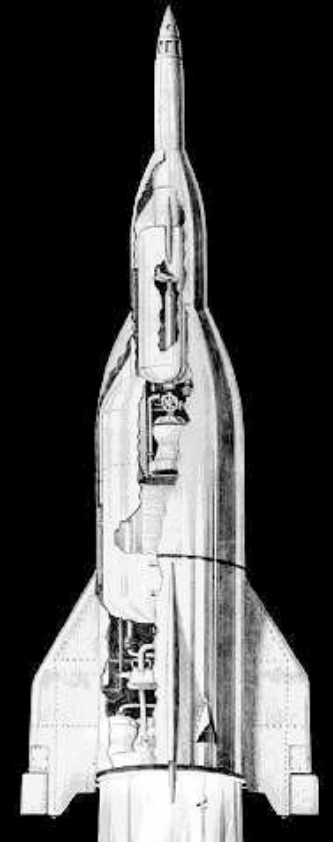
The Perliminary Design Group led by von Braun continued their concepts by stacking ever larger Aggregate rockets on top of each other to create an orbital launch vehicle. This spawned the A-11 booster, which the A-10 and A-9 would be launched atop. This concept would have had a payload of 500 kg and a gross mass of 500,000 kg. We can compare this to the Falcon 9, which has a liftoff mass of ~549,000 kg and a LEO payload of 22,800 kg while expendable.
Next came the A-12, with the A-11, A-10, and A-9 stacked on top of it to reach a LEO payload of 10,000 kg while weighing an absurd 4,100,000 kg in total. For reference, the Saturn 5 weighed 2,800,000 kg and had a LEO payload mass of ~150,000 kg.
The reason this is a fun exercise in designing orbital-class launch vehicles with very limited technology is that you end up with an absurd 4 kilotonne 4 stage launch vehicle to get a 10 tonne payload into orbit.